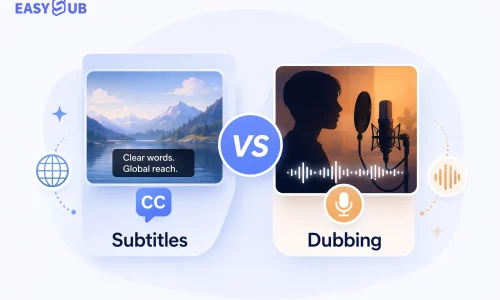
When localizing videos, you’ll inevitably face a core dilemma: subtitles vs. dubbing—which should you choose?
While subtitles and dubbing may seem like mere presentation differences, they involve complex considerations of cost, production timelines, SEO impact, and long-term scalability. This article systematically explores the differences between subtitles and dubbing in terms of cost, search engine influence, and scalability, helping you make decisions that align with your current stage.
Table of Contents
Subtitles vs Dubbing: Which Is Better for Global Video Marketing?
If you want to rapidly expand your content into more markets while keeping costs under control, subtitles are usually the better choice. If you prioritize viewer immersion or are working with content like films and animations, dubbing offers distinct advantages.
From an SEO perspective, subtitles provide indexable text that aids search matching. However, in terms of production efficiency, subtitles are faster to create and easier to modify. Furthermore, for most online content creators and corporate marketing teams, subtitles often deliver a higher long-term ROI (Return on Investment).
Why Subtitles Often Deliver Higher Scalability
When you consistently publish content, efficiency is key. The advantage of subtitles lies in their low cost, quick production, and easy modification. You don’t need to re-record for each language or repeatedly invest in production costs. Once the initial content is complete, you can rapidly generate multiple language versions.
In practice, many companies use subtitles to test different international markets first. This allows you to gauge which markets respond positively before deciding whether to scale up your investment.
Overall, if your goal is sustained growth (rather than a one-off, brand-level production), subtitles typically align better with the rhythm of scaling operations.
What Are Subtitles?
When creating video content, subtitles essentially convert spoken audio into on-screen text. Industry standards categorize subtitles into three primary types:
First, Same-language subtitles
Your video is in English, and the subtitles are also in English. This approach is commonly used to enhance comprehension and improve accessibility.
You retain the original language while providing text in the target language. This is the most common format for cross-border marketing and global expansion.
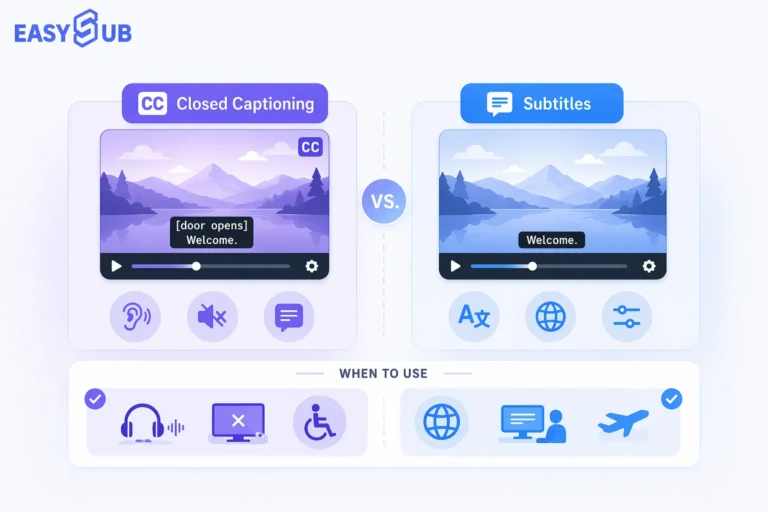
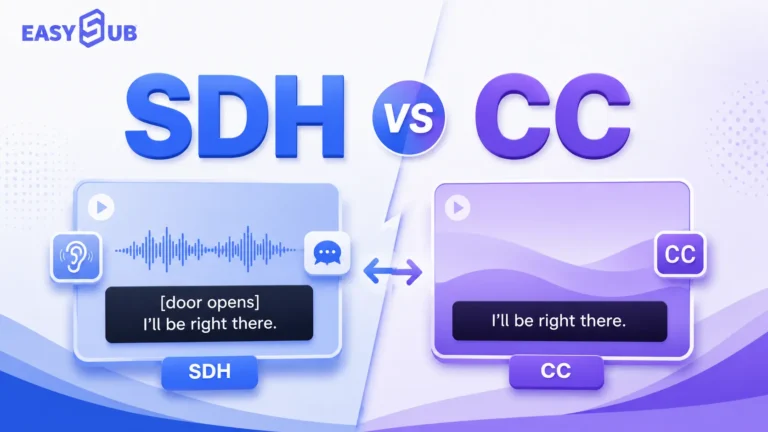
Third, Closed Captions (CC)
These captions typically include cues for ambient sounds, such as “[music]”. Primarily designed for hearing-impaired users, they comply with accessibility standards.
In summary, you might consider adding captions in the following scenarios:
- Publishing YouTube or social media videos
- Targeting non-native speakers
- Enhancing search visibility
- Meeting accessibility compliance requirements
Platform data shows that many social media users watch videos with sound off. Subtitles help reduce comprehension barriers and increase completion rates.
What Is Dubbing?
The core objective of dubbing is to enhance immersion. Viewers can understand the content directly through audio without needing to read subtitles. Dubbing primarily comes in three forms:
Human Dubbing
Recorded by professional voice actors. Offers more natural emotional expression but carries higher costs;
AI Voice Dubbing
Generates audio tracks using synthetic voices. Lower cost than human dubbing but with limited emotional range;
Lip-sync Dubbing
Synchronizes audio with on-screen lip movements. Complex production, commonly used in film and television content.
If you’re producing films, animations, or high-budget brand advertisements, voice dubbing offers distinct advantages. It’s also preferable when your target audience prefers a local language experience.
However, you must consider production timelines and costs. Each additional language version may require re-recording, leading to rapidly accumulating expenses for high-frequency content creators. Thus, voice dubbing is better suited for refined production rather than large-scale expansion.
Subtitles vs Dubbing Comparison: Cost, SEO, Scalability & ROI

Subtitles vs Dubbing: Side-by-Side Comparison
| Dimension | Subtitles | Dubbing |
|---|---|---|
| Cost | Low per-video cost; low marginal cost for additional languages | Each additional language requires re-recording; costs increase linearly |
| Production Time | Fast to generate and easy to edit | Requires recording, review, and post-production; longer turnaround time |
| SEO Impact | Provides indexable text; improves keyword matching | Replaces audio only; does not add searchable text signals |
| Viewer Experience | Preserves original voice; suitable for informational content | More immersive; suitable for cinematic content |
| Scalability | Easily scalable across multiple languages | Expansion costs increase with each added language |
| Best For | YouTubers, SaaS, education, e-commerce | Films, animation, high-end brand campaigns |
| Long-Term ROI | More cost-efficient for high-frequency content | Better suited for high-budget, single-project investments |
How to understand this comparison?
① If you publish content weekly, you’ll notice how crucial production efficiency becomes. Subtitles let you enter multiple markets without significantly increasing costs.
② For cinematic-level productions, dubbing enhances immersion. But this approach isn’t suitable for high-frequency content creation.
③ From an SEO perspective, subtitles offer structural advantages. Search platforms rely on text to understand content.
④ For scalable growth, subtitles offer greater sustainability. For single-project premium production, voiceovers are more suitable.
Choose the approach that aligns with your application scenario and growth stage.
Which Is Better for SEO and YouTube Growth?
If your goal is to gain more organic traffic, you need to prioritize search mechanisms over the format itself. Below is a breakdown from an SEO perspective.
Subtitles Provide Indexable Text Signals
Uploading subtitles essentially provides a complete, well-structured text version of your video. YouTube can directly read this content. This makes it easier for the system to accurately identify your core topic and match relevant search terms more precisely. High-quality subtitles significantly reduce misidentification bias, especially when dealing with specialized terminology, brand names, or technical expressions.
In contrast, voiceovers merely replace the audio track without adding new textual signals. Without subtitles, the platform primarily relies on automatic speech recognition (ASR) to understand content. ASR isn’t always reliable with accents, speaking speeds, or specialized fields. Therefore, from a search structure perspective, subtitles are clearly the more dependable choice.
Subtitles Expand Keyword Coverage
Title spaces are limited, accommodating only a few core keywords. But in actual video explanations, you often cover background context, provide supplementary details, and address common questions. These natural expressions are fully captured by subtitles.
When subtitles cover this semantic content, the system can recognize more related terms and long-tail expressions. This increases your chances of matching diverse search queries, especially more specific, precise question-based searches.
This semantic expansion is especially crucial for tutorials, SaaS demos, or product walkthroughs. Your audience typically searches for specific problems. Subtitles transform these question-based expressions into content that search systems can actually recognize.
Subtitles Improve Topic Clarity for YouTube

YouTube’s recommendation system relies on semantic understanding. Subtitles reduce speech recognition errors. When topic identification is clearer, your video is more likely to enter the correct content pool, further improving search and recommendation relevance.
Subtitles Support Google Video Search Visibility
Google also relies on textual signals to understand content themes when determining video relevance. Although videos consist of audio and visuals, search engines still require readable semantic information to complete matches. Subtitles precisely fill this gap by providing structured text.
Accurate subtitles enrich a video page’s semantic expression. Google can more easily assess the relevance between your video and user search intent. In competitive keyword environments, semantic clarity often determines visibility. If your growth strategy relies on sustained organic traffic, subtitles offer a structural advantage. They make your video not just watchable, but truly understandable.
Conclusion: SEO Perspective
From an SEO standpoint, subtitles offer structural advantages. While voiceovers enhance immersion, they do not improve text indexability. For sustained organic traffic acquisition, subtitles align more closely with SEO growth trends.
How Subtitles and Dubbing Impact Your Long-Term Budget
When producing just one video, the cost difference may seem negligible. But when you publish content weekly or target multiple countries, the structural gap rapidly widens.
Single-Video Cost Differences
Subtitling typically incurs lower production costs. Especially with automated tools, marginal costs become nearly controllable. Voiceovers, however, require recording, editing, and post-production. Even with AI voiceovers, each language remains a separate production pipeline. If you publish 50 videos annually, these per-video differences accumulate into a significant expenditure gap.
Multilingual Scaling Costs

When entering your second or third market, cost models diverge. Subtitles enable rapid multilingual deployment based on original content—no re-recording or lip-syncing required. Voiceovers demand separate audio tracks per language, with costs scaling linearly as languages increase.
For those testing multiple markets, this scaling disparity is critical and stark.
Long-Term Costs for High-Frequency Creators
If you’re a YouTube creator, SaaS marketing team, or online education provider, consistent content output is often essential. In this model, production efficiency and marginal costs determine long-term ROI.
Subtitles scale more easily and better control budget fluctuations. Voiceovers suit single-project precision work. But in high-frequency content environments, cost and timeline pressures gradually emerge.
When Should You Choose Subtitles?
- If your traffic primarily comes from search and recommendations, subtitles offer a distinct advantage.
- YouTube relies on text to understand content themes. Accurate subtitles enhance semantic clarity and improve match rates.
If You Publish Frequently
When you consistently release content weekly, efficiency determines cost. Subtitles enable faster production and more flexible revisions.
If You Are Testing Multiple Markets
When entering new countries, risk management is crucial. Subtitles let you validate language demand at low cost. You can then decide whether to scale up based on market feedback.
If You Care About SEO Performance
Subtitles provide indexable text signals, helping capture long-tail keywords. This is especially critical for tutorials, SaaS demos, and product walkthroughs.
When Should You Choose Dubbing?
For Cinematic or Story-Driven Content
For films, documentaries, or narrative content, voice-over is more suitable. Such content relies on emotional expression, not merely information delivery. Audiences seek immersion in the story, not frequent glances downward to read subtitles. In the film and television industry, localization typically includes professional voice-over work. This ensures a seamless viewer experience without disrupting the flow.

For Children’s Content
Voice-over offers distinct advantages when targeting young audiences. Children have limited reading speed and rely more heavily on auditory comprehension. In animation or educational content, voice-over enhances understanding efficiency. Many children’s content platforms prioritize local language audio tracks—a fundamental user experience requirement.
For High-End Brand Positioning
For premium brand advertisements or image films, voice-over enhances localized authenticity. Using native-language voices makes content resonate more deeply with target markets. This approach suits well-funded project-based productions, though production costs and timelines require careful evaluation.
Voice-over excels for refined content rather than high-frequency or ongoing releases. It offers distinct advantages when your core objectives are immersion and brand image, rather than large-scale expansion.
Final Decision Guide: Subtitles or Dubbing for Long-Term Growth?
Scalability and long-term organic reach: Subtitles are generally more suitable. They offer more controllable costs and better support SEO structural optimisation.
Pursuit of immersion and premium brand perception: Voiceovers hold the advantage. However, this approach is better suited to single-project productions rather than high-frequency content output.
For most content creators and corporate teams, subtitles often represent the more robust first step.
Scale Your Subtitle Workflow Without Increasing Production Costs
To achieve scale, you require three core capabilities and requirements:
First, rapid generation of high-accuracy subtitles.
Second, support for multilingual batch output.
Third, convenient editing and export of standard format files.
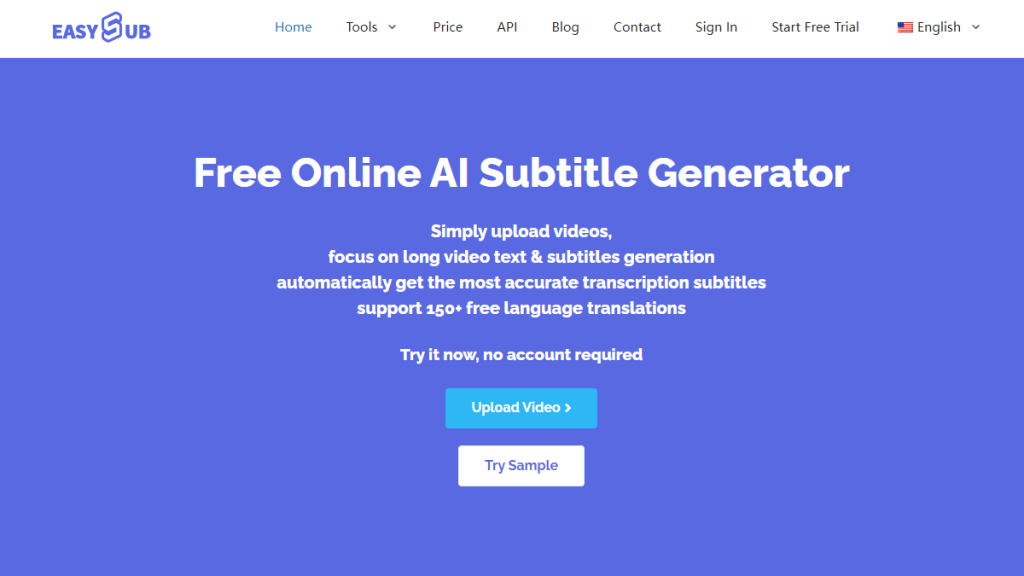
This is precisely where automated tools deliver value. Through AI captioning platforms like EasySub, you can generate well-structured subtitle files within minutes and rapidly scale to multiple language versions. This approach is particularly suited to high-frequency content creators, SaaS marketing teams, and cross-border e-commerce sellers.
You can use subtitles to validate your market before deciding whether to increase localisation investment. When subtitle generation becomes efficient and controllable, your content expansion capabilities will improve in tandem.
👉 Click here for a free trial: easyssub.com
Thanks for reading this blog. Feel free to contact us for more questions or customization needs!