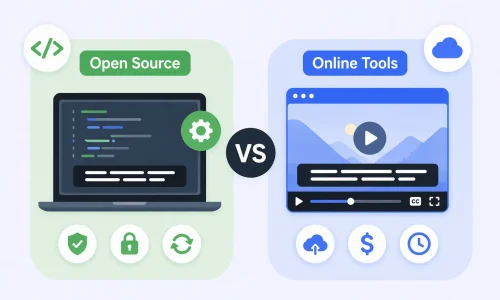
If you just want to quickly convert videos into subtitles, online subtitle tools are more convenient. But if you need to deploy and modify code yourself, open-source tools are more essential.
The biggest advantage of open-source subtitle generators is flexibility. You can modify the code, deploy it on a local server, and integrate it into your own tech stack. However, these tools typically require environment setup, dependency installation, and model maintenance—which can be costly for non-technical teams.
Online subtitle tools operate differently. You don’t need to set up environments or maintain speech recognition models. After uploading a video, the system automatically handles recognition, sentence segmentation, and timeline generation, significantly reducing production time.
For creators and corporate teams that need to publish videos consistently, workflow efficiency matters more than technical control. That’s why an increasing number of content teams are choosing to use online captioning platforms directly for their daily captioning needs.
Table of Contents
What Is an Open Source Subtitle Generator?
An open-source speech recognition system is a library or framework containing the source code for speech recognition systems. It is software that can automatically generate captions for videos or audio files, with its source code publicly available for you to freely download, modify, and deploy. It typically utilizes speech-to-text technology to convert speech in videos into text, then automatically generates caption files (such as SRT or VTT) synchronized with the audio timeline. When a video is input into the tool, the system automatically recognizes speech, generates text, synchronizes the timeline, and ultimately outputs a subtitle file. Many tools also support translation and multilingual subtitles.
The defining feature of open-source subtitle generators is publicly available code and self-hosting capability. Developers can run models on their own servers or customize functionality as needed—such as integrating automatic translation, batch processing videos, or embedding into video workflows.
Common open-source subtitle tools include Whisper, Vosk, Aegisub. These projects enable users to generate, edit, or synchronize subtitles while supporting multiple subtitle formats.
Pros and Cons of Open Source Subtitle Tools
Advantages
Free to Use: The biggest advantage of open-source subtitle tools is that they require no payment. Many tools leverage open-source speech recognition models like Whisper to directly convert video audio into subtitle files.
Self-Hosting Capability: You can deploy the tool on your own computer or server. Numerous open-source subtitle tools support offline operation, ensuring video data remains on your local device without uploading to the cloud.
Customizable Functionality: The code for open-source projects is publicly available. With technical expertise, you can modify the code, integrate automatic translation, or add batch processing scripts.
Limitations
High Installation and Configuration Barrier: Many open-source subtitle tools require installing Python, FFmpeg, model dependencies, and other environments. Without development experience, the setup process can be quite challenging.
Processing efficiency depends on hardware: Open-source subtitle tools typically run locally. If your computer lacks a GPU, processing large videos will take significantly longer.
Lack of complete workflow: Many open-source tools only handle the “speech-to-text” stage. Subtitle editing, translation, and format export often require multiple tools to complete.
Cost Comparison: Open Source vs Online Subtitle Tools
Is open source always cheaper? The reality isn’t that simple. The true cost lies not just in the software itself, but in the entire usage process. The advantage of open-source subtitling tools is freedom and control. But if you simply want to quickly generate subtitles and process video content, online subtitling platforms are undoubtedly a more time-saving and hassle-free choice.
Hidden Costs: Servers and Infrastructure
Open-source subtitle tools themselves are free, but running models requires hardware. For instance, deploying speech recognition models like Whisper often demands high-performance GPUs and substantial memory.
A GPU server suitable for running models can cost anywhere from thousands to tens of thousands of dollars. For occasional subtitle generation, such an investment simply won’t pay off.
Time Costs: Installation and Maintenance
Open-source tools typically offer only core functionality, like speech-to-text conversion. Tasks like subtitle segmentation, timeline adjustment, translation, and multilingual export often require piecing together multiple tools. You must install Python environments, configure dependencies, download models, troubleshoot runtime errors… Many developers spend hours or even days just getting the system up and running.
Online captioning platforms streamline these steps into a single workflow—simply upload your video to generate captions.
Hardware Costs: Processing Speed Differences
Caption generation is a computational intensive task. Without a GPU, processing large videos slows down significantly. Speech recognition models run several times faster on GPUs. This is why many teams ultimately choose cloud-based tools. Cloud services provide computing power directly, eliminating the need to purchase hardware.
Who Should Use Open Source Subtitle Generators?
Primarily, it’s best suited for the following groups:
The primary group: Developers
If you know how to code, open-source subtitle tools function like a set of technical building blocks. You can modify the code, integrate APIs, or even embed subtitle functionality directly into your own products. Many development teams integrate models like Whisper into their systems for this purpose.
AI or Product Development Teams
If you’re building AI tools, video platforms, or automation products, open-source caption generators offer significant value. You can leverage them as foundational capabilities for speech recognition, caption generation, or video processing workflows.
Technical Users
If you’re comfortable with Python, command-line interfaces, or server environments, open-source tools offer significant flexibility. You can deploy models independently, manage data, and build complete video processing pipelines.
Thus, users suited for open-source subtitle generators typically require technical expertise.
Who Should Use Online Subtitle Platforms?
For most users, the primary need is to quickly generate subtitles for video content. Without a doubt, online subtitle platforms make the entire process much easier!
YouTubers
Efficiency is everything when creating YouTube content. Subtitles not only enhance the viewing experience but also improve search match rates. Many creators upload SRT subtitles directly when publishing videos, as this helps the platform better understand the content (SEO).

SaaS Marketing Teams
When creating product demos, tutorial videos, or customer case studies, subtitles significantly improve comprehension. Especially when targeting a global audience, multilingual subtitles are practically essential. Online subtitle platforms can quickly generate and export multiple language versions.
E-commerce Teams
Short videos and product demos increasingly rely on subtitles. Many users watch videos with sound off, and captions help them quickly grasp product details. For e-commerce teams producing ongoing content, online subtitle tools dramatically boost productivity.
Why Many Creators Prefer AI Subtitle Platforms
Most creators and users directly utilize AI captioning platforms. The reason is simple: the efficiency gap is too significant. From uploading a video to the system automatically recognizing speech, generating captions, and synchronizing the timeline, the entire process takes only a few minutes.
First is automatic caption generation.
AI speech recognition has reached a high level of maturity. Models like Whisper achieve near-human accuracy in clear audio scenarios. Creators no longer need to manually transcribe subtitles, saving substantial time at this stage alone.
Next is multilingual subtitle translation.
If you aim to reach a global audience, multilingual subtitles are essential. AI subtitle platforms can translate the original subtitles into multiple languages directly after generation, enabling a single video to simultaneously cover multiple markets.
Finally, rapid export of standard subtitle files.
Platforms like YouTube, Vimeo, and video players typically use SRT or VTT formats. AI subtitle tools enable one-click export of these files, allowing direct upload for use on these platforms.
The following comparison chart clearly illustrates the difference:
| Feature | AI Subtitle Platforms | Open Source Subtitle Tools |
|---|---|---|
| Subtitle Generation | Automatically generates subtitles after uploading a video | Requires configuring models and environment |
| Multilingual Subtitles | One-click translation into multiple languages | Requires additional tools for translation |
| Subtitle Export | One-click export in SRT / VTT formats | Often requires manual processing |
| Ease of Use | Easy to start within minutes | Requires technical knowledge |
| Workflow Efficiency | Suitable for continuous content production | Better suited for technical projects |
Conclusion: Choosing Between Open Source and Online Subtitle Generators
Open-source subtitle generators function more like a suite of technical components. They suit developers or technical teams who need to deploy models themselves, configure environments, and modify code or integrate systems as required. For those engaged in product development or AI projects, this level of control is highly valuable.
Online subtitle platforms are much simpler. Upload a video, and subtitles are automatically generated, synchronized with the timeline, and exported as standard subtitle files. The entire process is straightforward—no environment setup or model maintenance required. For most content creators and marketing teams, efficiency trumps technical control. Subtitles are just one part of video production; it’s not worth spending significant time tinkering with tools.
To summarize: Technical teams are better suited for open-source tools. For content creators, just use online subtitle platforms!
👉 Click here for a free trial: easyssub.com
EasySub: Quickly generate subtitles, support multiple languages, and directly export SRT files. After uploading your video, the system automatically generates subtitles and synchronizes the timeline, making subtitle creation as simple as uploading a video.
Thanks for reading this blog. Feel free to contact us for more questions or customization needs!